Factory Router cuts inference costs by 63%
By Abhay Singhal - September 23, 2026 - 3 minute read
Product
Research
Share
By Abhay Singhal - September 23, 2026 - 3 minute read
Product
Research
Share
When we introduced Factory Router in June, benchmarks showed 20–25% lower inference costs while maintaining near-frontier task completion. Production results are now even stronger. Sessions using Factory Router cost 63% less in aggregate than the same workload would have cost at published frontier-model rates.
"Factory Router saved us thousands of dollars in inference costs in one week. For the router users, they saved a median of 72%. This has greatly extended our runway for AI investments while reducing the mental load of choosing the optimal model for every task."
Lower costs do not require assigning every task to a smaller model. Factory Router selects an efficient model when it can complete the workload reliably and moves to a stronger model when needed. In our published task-completion benchmarks, routed runs achieved 99% of Claude Opus 4.7’s pass rate on Terminal-Bench 2 and 96% on Legacy-Bench.
Factory Router is also now available in Factory Private (in private preview), making it the first and only on-premises model router built for software development agents. Teams can run routing and inference in their own VPC, on-premises infrastructure, or air-gapped network. This enables the world's most important systems to leverage sovereign and efficient model routing.
Weekly aggregate savings rose from 42% in late June to 63% in the week ending September 13, a gain of 21 percentage points. Over the same period, routed session volume grew roughly fourfold.
The increase reflects stronger efficient models, lower inference prices, continued improvements to Factory Router, and organization-specific routing guidance.
As efficient models become more capable, Factory Router can assign more software engineering tasks to them while reserving stronger models for work that requires them. A familiar bug fix or refactor can therefore become less expensive to execute even when the task itself has not changed.
Factory captures these improvements by evaluating new models, adding them to the Router when they demonstrate Pareto-optimal performance, and refining model selection using aggregate production signals. These gains become part of automatic model selection, so individual engineers do not need to evaluate every new model themselves.
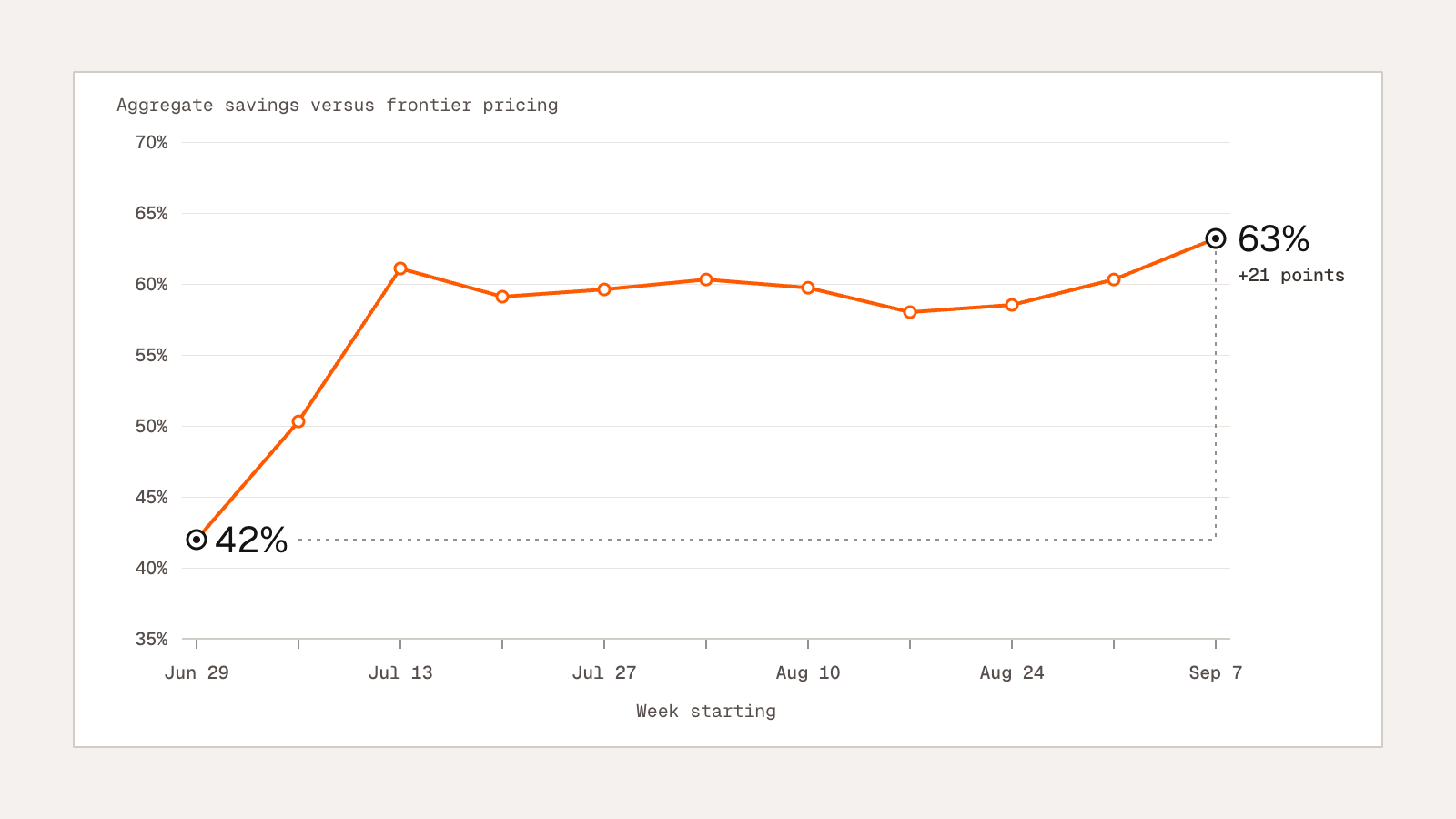
Weekly aggregate savings compared with frontier pricing, June 29 to September 13, 2026. Savings axis: 35–70%.
Organizations are also improving savings by adapting Factory Router to the way their teams work. Admins can configure routing guidance and rules based on workflow patterns, codebase context, toolchains, model preferences, and cost requirements.
For example, a team can identify documentation updates and mechanical refactors as routine while calling for deeper reasoning for changes to a critical service. This guidance allows Factory Router to make the same tradeoff consistently: use efficient models for familiar tasks and stronger models when the organization's requirements call for them.
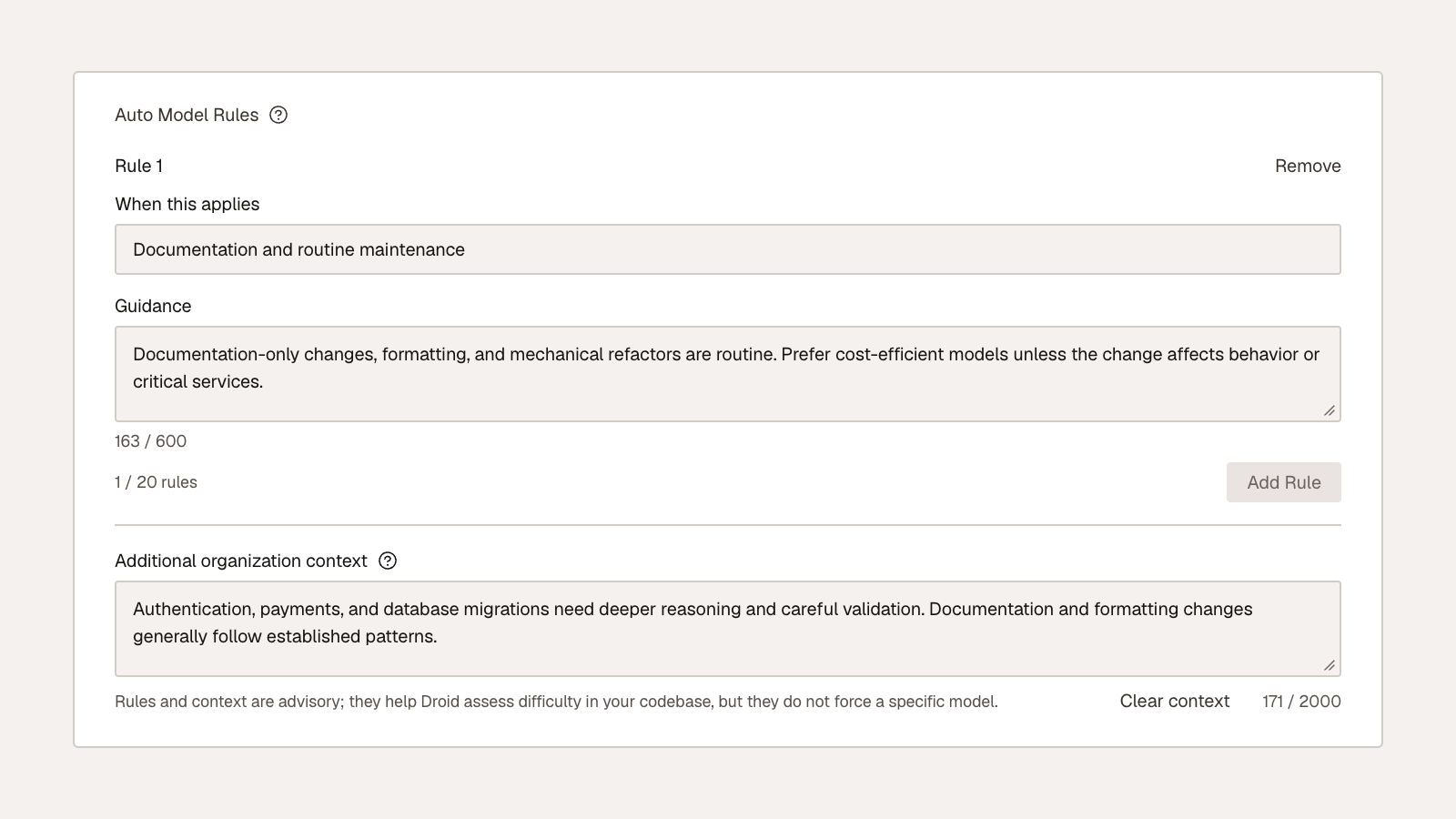
Admin routing guidance and rules in Enterprise Controls. Illustrative configuration rendered from the production component.
As adoption grows, organizations are also routing more recurring and autonomous workflows. This increases the share of tasks suited to efficient models and contributes to higher aggregate savings.
The aggregate trend also appears at the session level. From September 5 to September 18, 84% of routed production sessions saved at least 50% compared with frontier-model pricing. Roughly one-third saved at least 80%, and median savings per session were 72.5%.
Across the same period, aggregate savings were 60%. These results cover production sessions using Factory-managed inference at our published rates.
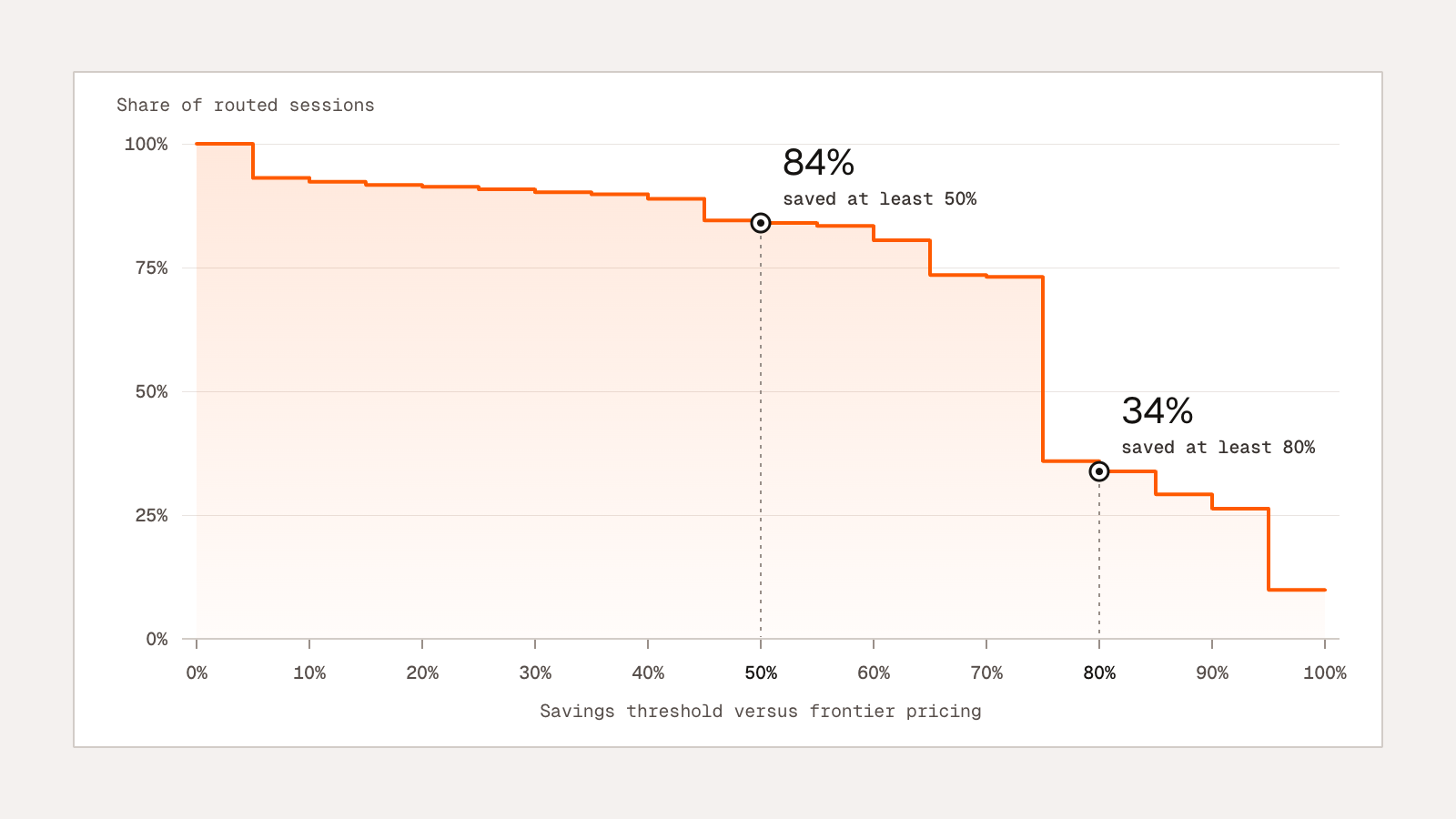
Share of routed production sessions saving at least a given amount compared with frontier-model pricing, September 5 to September 18, 2026.
The same routing approach now runs in Factory Private (private preview). Teams can use Auto Model with internally hosted model endpoints, including in air-gapped deployments, while retaining their existing identity, network, and security controls.
Both stages stay inside the organization’s environment. The router sends model-selection calls to the organization’s configured endpoints, and Droid sends task-execution calls to those endpoints. If Droid needs a stronger model, it can move to another approved model in the configured set. No request needs to go to Factory-managed inference.
The Factory control plane and sensitive data also reside in the organization's VPC or on-premises environment. Developers continue to use the same Droid workflows while the organization retains control over where routing and inference run.
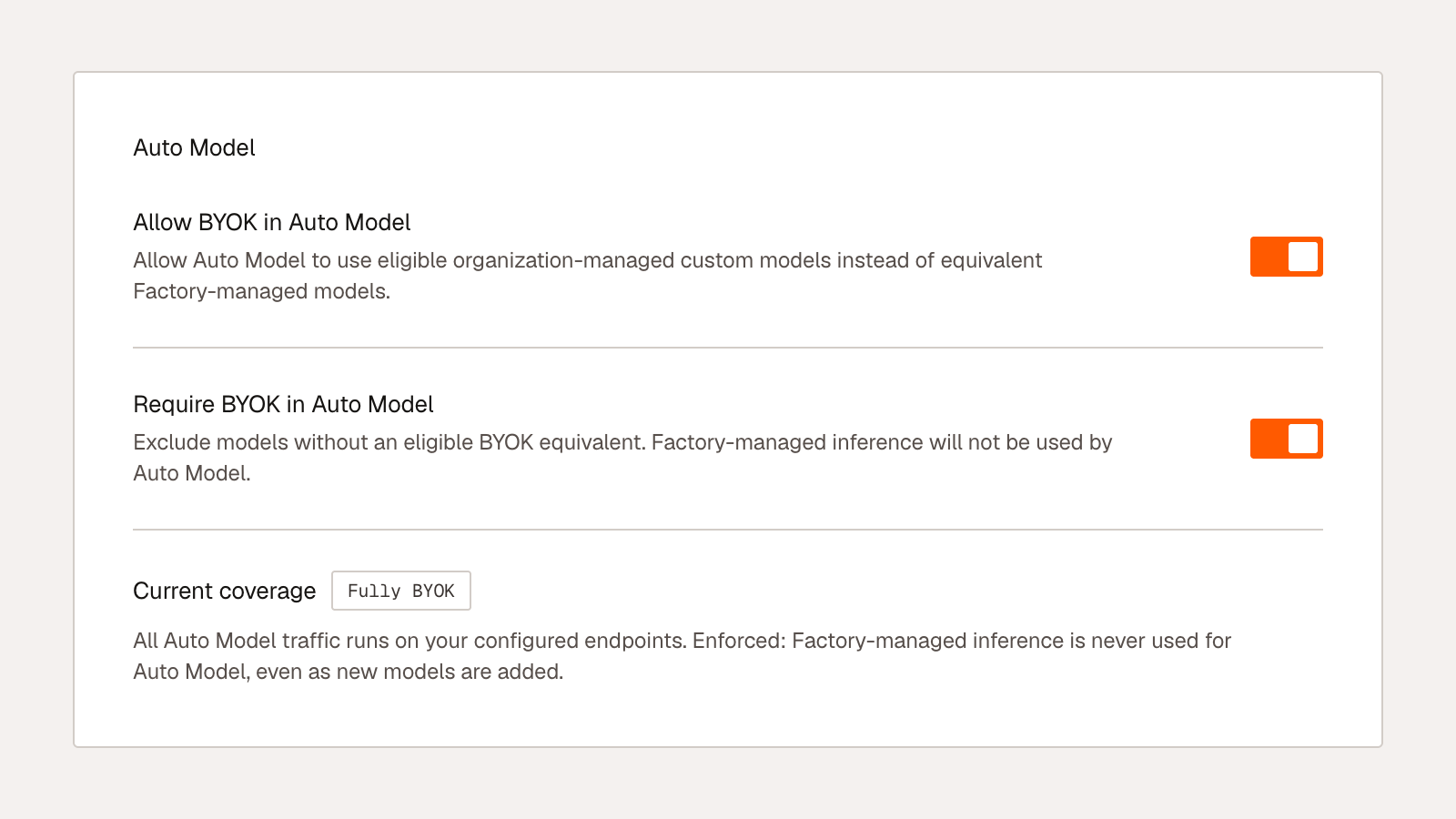
Illustrative configuration rendered from the actual product component.
Admins enforce these endpoint restrictions with Require BYOK in Auto Model, the enterprise setting for bring-your-own-key routing. Models without an approved endpoint mapping are excluded. Enterprise Controls displays Fully BYOK when all Router inference uses the organization’s endpoints. These requirements continue to apply as Factory adds models, and organization-specific routing guidance and rules remain in effect.
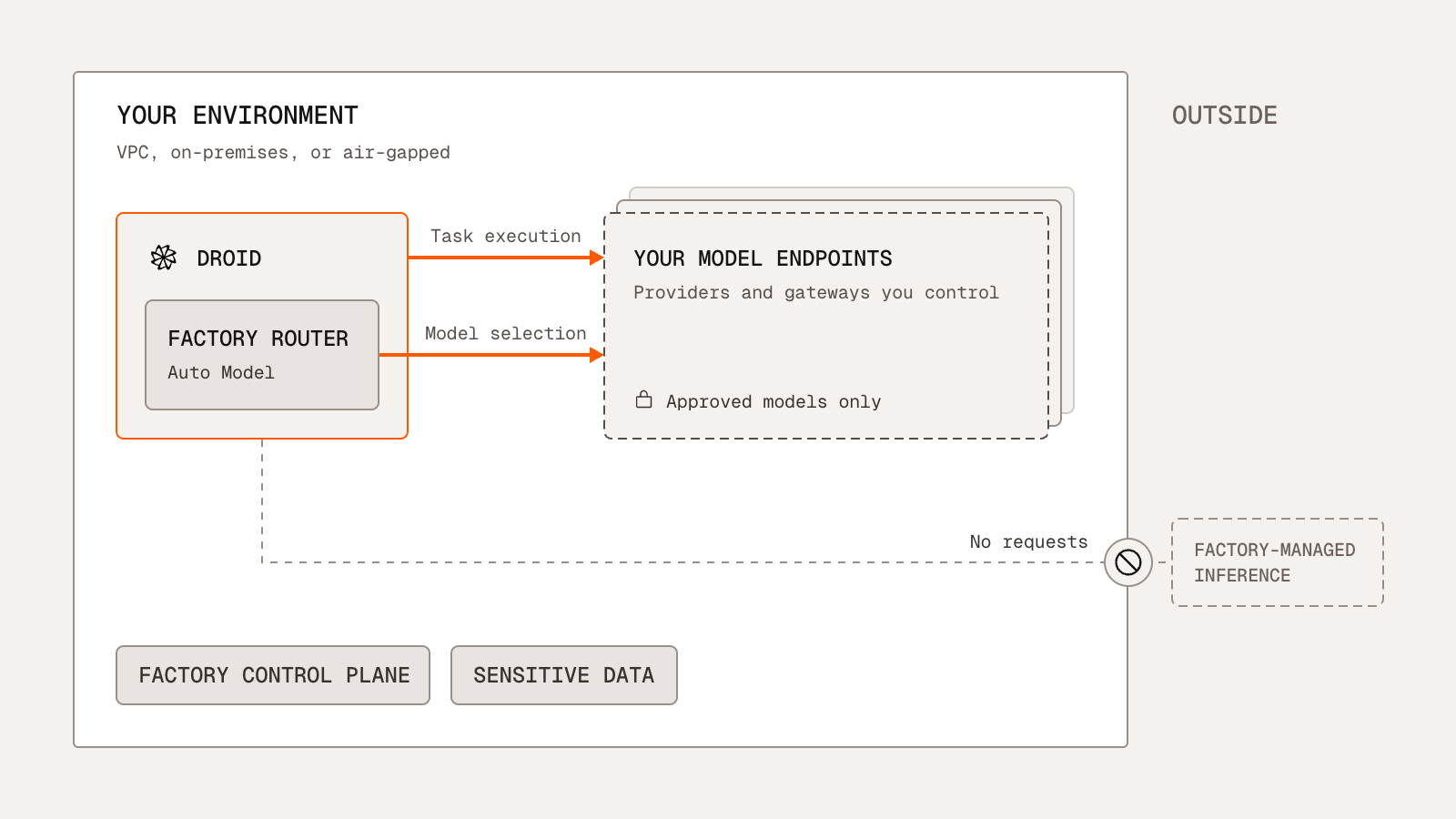
Factory Private keeps model selection and execution inside your environment.
Savings in Factory Private depend on each organization’s configured models and the prices it pays for them.
Factory Router is available as Auto Model in Droid’s model picker. Organizations can make it the default model and configure routing guidance and rules in Enterprise Controls. To try it out for your organization, contact Factory.
Start building