November 18, 2026 - 5 minute read
How NVIDIA Used Factory to Post-Train Nemotron
Customers
Share this article
November 18, 2026 - 5 minute read
Customers
Share this article
NVIDIA ran Factory’s platform inside its own sealed-off network, so researchers could safely post-train Nemotron models.
Watch the video to see how NVIDIA and Factory worked together to post-train Nemotron.
NVIDIA chose Factory to post-train Nemotron models because Factory offers an enterprise agent platform that can be deployed on-premises in fully air-gapped environments. Factory worked directly with NVIDIA researchers to customize the platform for their experiments while keeping all data and execution traces within NVIDIA’s security controls.
Open models such as Nemotron provide security and control over the sensitive data of individuals and enterprises because researchers and developers can study, adapt, and deploy them in environments that meet their own technical, security, and operational requirements. When a model works as an agent, that protection holds only if the harness (the software that lets it run commands, edit files, and call tools) runs there too.
NVIDIA needed that capability for its own research on post-training Nemotron models to improve their agentic capabilities.
NVIDIA works with several agent harnesses, but Factory was the only commercially supported enterprise platform deployed on-premises in NVIDIA’s air-gapped environment and used to post-train Nemotron 3 Ultra. Because Factory’s platform is commercially supported and can be deployed in fully air-gapped environments, researchers had an enterprise-ready harness, backed by a Factory team that could customize it for their experiments, without taking their work outside NVIDIA’s security controls. For enterprises adopting open models, NVIDIA’s deployment demonstrates that a commercially supported harness can run entirely behind their own firewall.
Inside NVIDIA’s air-gapped environment, researchers ran agent experiments, inspected execution traces, and investigated tool-use failures while post-training Nemotron 3 Ultra and Nemotron 3.5 Super VL. With the Factory harness behind NVIDIA’s firewall, researchers could work with their own data within their security and compliance controls. NVIDIA then incorporated the terminal-use data generated using the Factory harness into a broader multi-harness training pipeline to improve tool use and instruction following across different environments.
“Factory was a great partner for post-training Nemotron. Droid was the only commercially supported harness we deployed in our air-gapped environment, supporting long-running agents with full execution traces. Factory collaborated with us to analyze those traces to improve the model’s planning, tool use, and error recovery.”
Jian Zhang, Director, Applied Research for Nemotron Post-Training, NVIDIA
While post-training, NVIDIA’s Nemotron team faced three related challenges.
“Factory knows what it takes to deploy agents in a large enterprise, from running fully air-gapped inside our own network to working side by side with our researchers. The Factory harness helped us train Nemotron for long-running agents while keeping full control over our data, which is what secure, sovereign AI depends on.”
Udi Karpas, Senior Product Manager, Nemotron, NVIDIA
Factory deployed its platform on-premises in an air-gapped environment, operating within NVIDIA’s security and compliance controls. Researchers could run terminal-use evaluations, inspect execution traces, generate training data, and test models in a sandbox.
NVIDIA controlled the entire deployment environment and could apply its own security policies to the model and harness. The air gap gave researchers more room to experiment, not less. Because the model and the Factory harness were fully sandboxed behind NVIDIA’s firewalls, researchers could run those experiments without worrying that one would “mess up something outside,” as Jian put it. Factory’s team provided technical support for the customization and configuration changes NVIDIA’s researchers needed.
The Factory harness’s planning tools provided a test of instruction following. They required Nemotron to draft tasks, update its plan as work progressed, and adhere to specific formatting rules. Factory analyzed Nemotron’s traces with NVIDIA to identify specific failure modes, from hallucinated tool calls to incorrect argument formats and poor error recovery.
“Droid as an enterprise harness really stood out because of the very strong instructions that were embedded into the harness. The system prompt has a very strong kind of steering for the model to plan…and draft its own tasks across its own trajectory of working through a problem.”
Junkeun Yi, Research Scientist, Agentic Post-Training for Nemotron, NVIDIA
Factory advised NVIDIA on tailoring the Factory harness to specific experiments, including adding hooks to capture failure points. Factory’s team also provided detailed evaluations of Nemotron on proprietary datasets, including Legacy Bench, giving NVIDIA targeted feedback that helped identify model weaknesses and accelerate performance improvements.
NVIDIA also used the Factory harness to reproduce failures and generate training examples of correct tool use. Its training pipeline combines supervised fine-tuning (SFT), which teaches desired behavior through examples, with reinforcement learning (RL), which improves behavior using feedback from evaluated attempts.
For Nemotron 3 Ultra, NVIDIA trained on 20,000 rows of data using the Factory harness, applying PivotRL, a reinforcement-learning method to address hallucinated tool calls and other tool-use errors.
After training, NVIDIA returned updated checkpoints to Factory for further evaluation and trace analysis, helping identify which behaviors had improved and which needed more work.
NVIDIA also wanted Nemotron’s capabilities to transfer beyond the Factory harness. The Factory harness’s configurable tools and instructions, together with its ability to adapt its own configuration, supported different research use cases and training setups.
Factory worked with NVIDIA to vary the Factory harness’s tools, configurations, and instructions. NVIDIA analyzed the resulting traces, gathering early feedback on model behavior without waiting for broader real-user data. NVIDIA incorporated data from these variations alongside data from other harnesses in its broader training pipeline, with the goal of teaching Nemotron to adapt to different execution environments.
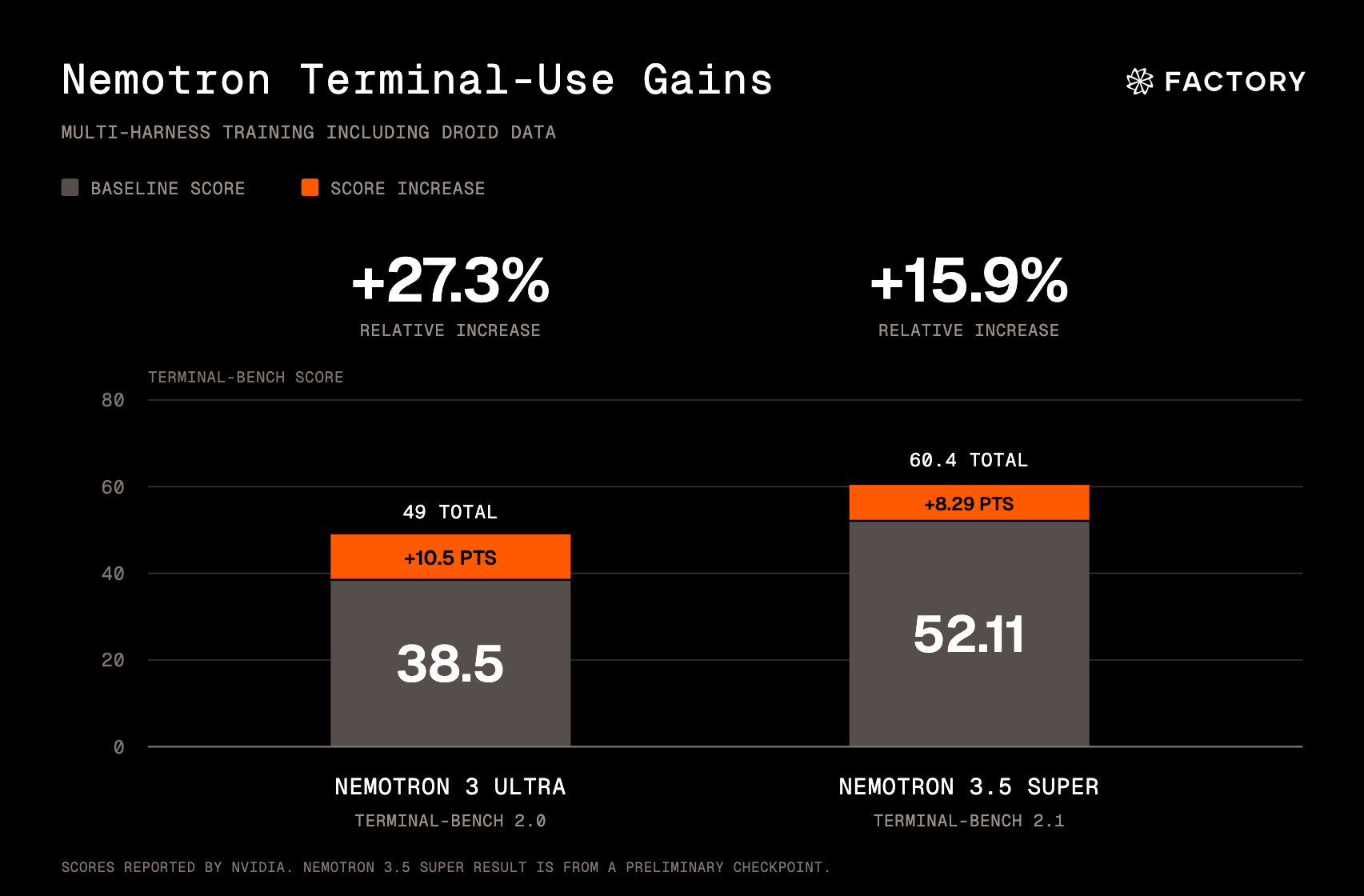
NVIDIA evaluated its own model checkpoints and reported improvements in terminal-use performance and tool-use behavior:
The gains extended beyond the Factory harness. As Junkeun Yi explained, “Because of these in-depth behavior analyses, we were able to improve our model on not just Droid, but in various general agentic instruction following capabilities.”
The results illustrate how behavioral insights from an enterprise harness like Factory’s can inform a broader model-training pipeline. The benchmark improvements reflect NVIDIA’s multi-harness training work, which incorporated data generated in the Factory harness.
As agentic systems tackle longer-running tasks, researchers need ways to understand and improve model behavior beyond final task outcomes.
Jian Zhang, Director, Applied Research for Nemotron Post-Training at NVIDIA, expects agent research to focus increasingly on longer-running tasks and models that help improve AI systems themselves.
NVIDIA’s work with Factory shows how that can work in practice: agents run inside a controlled environment, and every execution trace stays available to inform the next round of training.
Junkeun Yi described what he valued most about the collaboration with Factory:
“The best part of working with Factory was looking at problems in the right way, which is the behavior and the trajectory analysis way, whereas they could have been just looking at numbers and improving benchmarks.”
Junkeun Yi, Research Scientist, Agentic Post-Training for Nemotron, NVIDIA
For AI teams post-training models, Factory provides an enterprise harness for running agents in controlled environments and examining their behavior in detail. NVIDIA’s work with Factory demonstrates how this infrastructure can help researchers turn observed failures into actionable insights for post-training.
This work reflects the shared commitment to open models that brought NVIDIA and Factory together. NVIDIA releases model weights, training methods, and data so other teams can study its work and build on it. Factory’s contribution to Nemotron supports that goal, helping researchers, entrepreneurs, enterprises, and individuals adapt open models to their own needs and environments.
Contact sales